
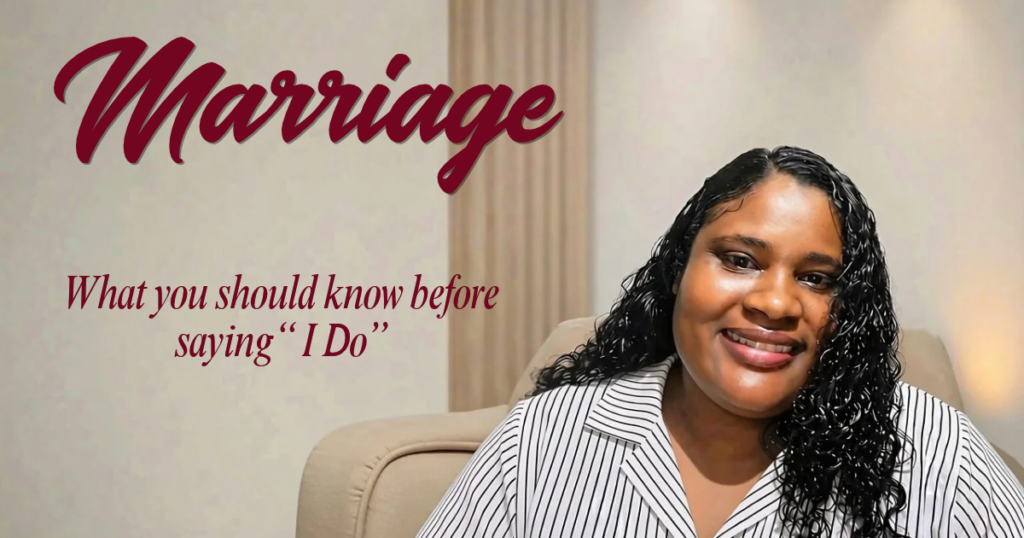
By God’s grace, I want to discuss marriage and entering into marriage, particularly the things that we should know before entering into a marital relationship as a single individual.
Jesus and Marriage
Jesus Christ performed His first miracle at a wedding. We find this in John 2:1–11, where Jesus attended the marriage in Cana of Galilee and turned water into wine.
Jesus honoured and endorsed marriage by His presence at the wedding in Cana. It is significant that His first recorded miracle took place at a wedding celebration.
My beloved, marriage is not something that should be entered into carelessly. It is a sacred covenant that should be honoured and respected. Just as Jesus was invited to that wedding, we should invite Jesus into our marriages and allow Him to remain at the centre.
When Christ is at the centre of a marriage, we have His Word to guide us through the good times, the difficult times, and the different seasons that marriage may bring.
What Is Marriage From a Biblical Perspective?
Marriage is a legal union between two adults, male and female, who come together. It is a sacred covenant between the male and the female who have been joined together.
How Do I Know I Am Ready to Be Married?
You know you are ready to get married when you know who you are and whose you are.
When you are entering a marriage, you should enter full. That way, when you both are full, you will pour into each other and you will be overflowing.
When you get married and you are empty, you will constantly draw from your partner, which can cause strain on the relationship.
For example, if you enter marriage expecting your spouse to be the only source of your happiness, confidence, purpose, peace, or emotional stability, you may place a burden on them that they were never meant to carry. Your spouse can love you, encourage you, and support you, but they cannot fill every empty place within you.
My beloved, know who you are and whose you are before entering marriage. Develop your relationship with God, work on yourself, know your purpose, and learn to be emotionally and spiritually healthy.
When you enter marriage, you should not simply be looking for someone to fill you; you should also be coming with something to pour into the life of your spouse.
Marriage should be two people pouring into each other, not one person constantly pouring while the other is constantly taking.
My beloved, age does not prepare us for marriage; maturity does. There are many individuals who have the age to get married but do not have the maturity needed to maintain a healthy marriage.
Your body also does not tell you when you are ready for marriage. Your flesh loves the things of the flesh, so do not say, “I feel as if my body is ready.”
Marriage requires spiritual, emotional, mental, and practical maturity.
Sometimes you have to tell your body, “Behave yourself, in Jesus’ name!”
Do not allow feelings, pressure, loneliness, or physical desire to push you into a marriage you are not prepared for.
Marriage Is Not a Fairytale
Marriage is not a fairytale; it takes hard work.
Love alone does not keep a marriage; maturity is also needed. At times, you hear people saying that they are getting a divorce. You may ask, “Do you still love him or her?” and the answer is, “Yes, I do.” Yet they are still going through with the divorce.
This is why I say that love alone does not keep a marriage; maturity does. You can love someone and still lack the maturity needed to communicate, forgive, compromise, control your emotions, accept correction, and work through difficult seasons.
Before entering marriage, maturity is an important instrument that you should have. Love may bring two people together, but maturity helps them to work through the challenges that come with marriage.
1. Know Yourself First
Before entering into marriage, you should know yourself first.
Understand your values, weaknesses, goals, expectations, and what you truly want from marriage.
Before you try to know someone else, you need to have an understanding of yourself.
2. Know the Person You Are Considering Marrying
Do not be in a rush.
Learn their character, habits, temperament, beliefs, and how they behave when they are angry, disappointed, or under pressure.
Do not only pay attention to how someone treats you when everything is going well. Pay attention to their behaviour when things do not go their way.
3. Make Sure You Share the Same Values on Major Issues
Discuss important areas such as faith, how many children you want, how you plan to train them up, and finances.
It is best that both husband and wife have the same beliefs spiritually speaking. Even when two individuals are Christians, differences in beliefs can create challenges in a marriage.
For example, if one person is an Adventist and the other attends a Sunday church, there may be differences concerning the Sabbath, church attendance, raising the children, and other spiritual practices.
These things may seem small while dating, but they can become major issues after marriage.
Therefore, discuss your beliefs before marriage. Do not assume that because you both believe in God, you agree on everything spiritually.
4. Understand That Marriage Requires Commitment
Marriage is not only about feelings. Feelings can change, but commitment means choosing to stay, work through difficulties, and grow together.
If you marry someone only because of how you feel about them or because of how they look, you may struggle when those feelings change or their appearance changes.
Marriage requires more than attraction. It requires love, patience, forgiveness, understanding, sacrifice, and a decision to remain committed to each other.
First Corinthians 13:4–8 teaches us that love is patient and kind. It is not envious, boastful, proud, self-seeking, or easily angered. Love rejoices with the truth, protects, trusts, hopes, perseveres, and never fails.
5. Discuss Finances Before Marriage
Money is one of the important areas that should be discussed before entering marriage.
Talk openly about income, debt, spending habits, saving, bills, financial responsibilities, and expectations.
You should also discuss how you plan to manage your money. Will you have a joint account, separate accounts, or both? How will the bills be divided?
You also need to know how your partner feels about 50/50. You may believe that everything should be divided equally, while your partner may believe that one person should carry more of the financial responsibility.
If these expectations are not discussed before marriage, they can cause serious disagreements and havoc in the marriage.
Do not assume that your partner thinks the same way you do about money. Talk about it before you say, “I do.”
6. Talk About Children
Discuss whether you both want children, how many children you want, parenting styles, discipline, and religious upbringing.
Do not wait until after marriage to discover that one person wants children and the other does not, or that you have completely different ideas about how the children should be raised.
7. Observe How the Person Communicates
A healthy marriage needs honesty, listening, respect, and the ability to discuss problems without insults, threats, or silence.
Communication is very important because disagreements will happen. The question is not whether you will disagree; it is how you will handle those disagreements.
It is vital for each individual to work on themselves because no one is perfect. When your imperfections are observed by your partner, do not become angry or bitter, and do not allow pride to fill your heart.
Instead, work on yourself and strive to become better. Be willing to accept correction and recognize the areas where you need to grow.
Remember, marriage is not only about expecting your partner to change; you must also be willing to work on yourself.
8. Pay Attention to Warning Signs
Warning signs such as controlling behaviour, constant lying, violence, excessive jealousy, addiction, disrespect, and manipulation should never be ignored.
This is especially important for young adults who are entering relationships.
If an individual cannot respect your boundaries, your rules, your dos and your don’ts before marriage, do not expect them to suddenly respect them after marriage.
For example, if you say, “I do not want to have sex or become sexually intimate before marriage,” and the person keeps pressuring or forcing you, recognize that as a serious warning sign.
Someone who truly respects you will also respect your boundaries.
Do not ignore warning signs because you are in love.
The Lord shared with me that a lot of individuals do not set boundaries before entering into marriage. Boundaries are necessary, beloved.
You need to make your expectations clear before marriage. Discuss your dos and don’ts, what you will and will not tolerate, and the things that are important to you.
Do not wait until after marriage to reveal boundaries and expectations that should have been discussed before. Clear boundaries can help both individuals understand and respect each other and prevent unnecessary conflicts in the marriage.
9. Understand Your Partner’s Family Background
Family experiences can influence how a person understands marriage, conflict, affection, discipline, cleanliness, responsibility, and even communication.
Many marriages struggle because two people were raised very differently.
For example, the husband may come from a home where everything was kept neat and tidy, while the wife may come from a home where cleanliness was handled very differently.
If they do not understand each other’s background and expectations, this can cause serious conflict in the marriage.
The same can happen with money, parenting, household duties, showing affection, handling disagreements, and respecting boundaries.
This is why it is important to learn about each other’s family background before marriage.
You are not only marrying a person; you are also joining together two different ways of life.
Talk about these differences before marriage and decide together what kind of home you want to build.
Consider the Spiritual Background
When you marry someone, you are not only joining your life with that individual; you are also entering a family with a history and a background.
As believers, we should understand that spiritual warfare is real and that Scripture teaches about the influence of sin and spiritual forces.
Some families may have long-standing patterns of bondage, destructive behaviours, or spiritual practices that have affected generations. These are sometimes referred to as generational curses.
If you enter a marriage without being spiritually prepared, these issues can become a source of serious conflict.
This is especially important when you are walking in the light of Christ. Darkness does not welcome light.
Ephesians 6:12 (KJV):
“For we wrestle not against flesh and blood, but against principalities, against powers, against the rulers of the darkness of this world, against spiritual wickedness in high places.”
Therefore, before marriage, pray, seek God for wisdom and discernment, and learn as much as you reasonably can about the person’s family, beliefs, values, patterns, and spiritual background.
Do not enter marriage blindly. Be spiritually prepared and keep Christ at the centre of your relationship.
10. Do Not Marry Hoping to Change Someone
Marriage usually magnifies what is already present in an individual’s life.
If something is seriously troubling you before marriage, do not assume that it will simply disappear after marriage.
This is where many individuals get into trouble. They say, “She is a nice girl; maybe I can change her,” or, “He is a nice man; maybe after we get married, he will change.”
My beloved, you are not Jesus. You cannot change anyone’s heart.
You can encourage them, pray for them, counsel them, and show them the right path, but ultimately, the decision to change belongs to them.
Never enter marriage based on who you hope someone will become.
Pay attention to who they are now. If change is necessary, allow them to demonstrate that change before you make the commitment of marriage.
11. Learn How to Resolve Conflict
Disagreements will happen. What matters is whether both people can apologize, forgive, compromise, and communicate respectfully.
Never forget common courtesy.
The Lord has taught me that many individuals forget some of the basic teachings they received at home and even in basic school.
Some of the first things we are taught as children are to say, “Please,” “Thank you,” “Excuse me,” and “I am sorry.”
Yet, as simple as these words are, many individuals forget to use them, especially in marriage.
One of the most important things is, “I am sorry.”
When you have hurt your spouse or you know that you are wrong, say you are sorry and genuinely mean it.
A sincere apology can be like ointment on a wound; it can help to bring healing to a hurting heart.
However, many people allow pride to fill their hearts. They know they are wrong, but they refuse to apologize.
My beloved, marriage has no room for that kind of pride.
When you are wrong, humble yourself and say, “I am sorry.”
Never become so familiar with your spouse that you forget basic courtesy, respect, and kindness.
Be Kind to Your Spouse
A lot of people are kind to strangers and to almost everyone they come in contact with, with the exception of their own spouse.
They speak politely to others, smile with others, and show others respect, but when they get home, their spouse receives completely different treatment.
My beloved, this should not be so. Your spouse deserves your kindness too.
Continue to make an effort to impress your spouse even after marriage.
Compliment them. Tell them when they look nice. Appreciate the things they do. Speak kindly to them and make them feel valued.
Do not become so comfortable in your marriage that you begin to take your spouse for granted.
The same kindness and attention you showed while trying to win their heart should continue after you have won it.
Never stop making your spouse feel loved, appreciated, respected, and special.
12. Understand That Marriage Requires Sacrifice
You will sometimes have to put aside personal preferences for the good of the relationship.
Marriage cannot always be about “me.” There will be times when both husband and wife have to make sacrifices for the good of the marriage.
13. Maintain Healthy Boundaries
Marriage does not mean controlling one another.
Both partners should still be treated with dignity and respect.
Celebrate each other’s success. When your partner accomplishes something, celebrate with them and let them know you are proud.
Remember, love is not selfish, but love is kind.
14. Seek Wise Counsel
Premarital counselling can help couples discuss important matters they may not have considered.
After marriage, if issues arise that you are unable to resolve, seek counselling. Do not allow pride to prevent you from getting help when help is needed.
Many individuals see the intervention of a counsellor in a negative way. Some see it as a sign of weakness, but it is not weakness.
When you recognize that you need help and are willing to ask for it, that is not weakness; it is strength.
Matthew 7:7 says:
“Ask, and it shall be given you; seek, and ye shall find; knock, and it shall be opened unto you.”
My beloved, there is nothing wrong with seeking wise counsel. Sometimes an outside perspective from someone who is trained, wise, and trustworthy can help you see things that you and your spouse may not be able to see on your own.
15. For Christians, Make God the Foundation
Do not only ask, “Do I love this person?”
Also ask, “Will this relationship help us both grow closer to God?”
My beloved, marriage requires more than love and attraction. It requires maturity, commitment, communication, forgiveness, sacrifice, respect, kindness, and most importantly, God at the centre.
Do not rush into marriage because of age, loneliness, pressure, physical desire, or because everyone around you is getting married.
Know yourself. Know the person you are considering. Pray. Observe. Communicate. Seek God for wisdom.
Marriage is a sacred covenant. Enter it prayerfully, wisely, and with an understanding of the commitment you are making.
And when you enter into marriage, continue to invite Jesus into your home, into your decisions, into your difficulties, and into every season of your marriage.
A Final Word
My beloved, as I close, remember that marriage is a beautiful covenant, but it is also a serious commitment.
For those who are single, do not rush the process. Take your time. Pray, observe, seek God for wisdom, and allow Him to direct your steps. It is better to wait than to enter into a marriage that God never intended for you.
For those who are already married, never stop working on your marriage. Continue to love, forgive, communicate, appreciate, and be kind to your spouse. Do not allow pride or the pressures of life to cause you to neglect the person you once prayed for.
There will be good seasons and difficult seasons, but do not allow a difficult season to make you forget the covenant you made.
Most importantly, keep Jesus Christ at the centre of your marriage. Invite Him into your decisions, your disagreements, your finances, your family, your struggles, and your plans for the future.
My beloved, marriage is not about finding a perfect person, because none of us is perfect. It is about two individuals who are willing to grow, learn, forgive, sacrifice, and walk together with God.
So, whether you are preparing for marriage or you are already married, seek God for wisdom. Allow His Word to guide you, and never stop working to build a home where love, respect, kindness, forgiveness, and the presence of God can dwell.
May God strengthen our marriages, prepare those who desire to be married, give us wisdom to make the right decisions, and help us to build relationships that honour Him.
God bless you, my beloved, in Jesus Christ’s mighty name.